Growth Library
Insights > Growth Library
Make the next growth decision with better evidence.
Start from the customer’s job. Nobody buys a crane, a loader or a controller for its own sake. They hire it to get a job done – and they judge it by how well that job goes.
Growth Library applies jobs-to-be-done and outcome-led research to industrial technology decisions: what to build, what to prove and what to scale. Open guides, research and tools – start to explore!

The right questions, asked in the right order, lead directly to the answers that matter. Ask the wrong ones, or ask them out of sequence, and you end up defending a decision that was never the real one to make.
Miika Okko — Principal Advisor, Industrial Innovation & Growth
The approach behind the library
Technical capability is not the same as commercial clarity.
Industrial companies are no longer short of technical possibilities. Machines are connected, data exists and AI opens new ways to automate and support customers. The harder question is which opportunity customers will actually adopt and pay for. Workshops recycle assumptions, market research stops at findings, and building first makes the wrong direction expensive. The answer starts one step earlier – with the customer’s job.
Four questions behind every growth decision
1 · Job
Job
What is the customer trying to get done?
Job statement & job map
Describe the job without your product: verb + object + context. If the sentence would stay true when the machine changes, you have found the job. The person doing the job is rarely the one who signs the order – know both.
2 · Outcome
Outcome
How does the customer know the job went well?
Importance × satisfaction
Write measurable outcome statements: direction + metric + object + situation, for example “minimise the number of logs cut to the wrong length”. Then ask how important each outcome is and how satisfied customers are with today’s alternatives.
3 · Signal
Signal
Where can you see how well the job goes today?
Data map
Interviews tell you what matters. Machine and service data show how well it goes: waiting, retries, interrupted cycles, manual overrides. Most dashboards stop one level too early – at machine health instead of the customer’s result.
4 · Solution
Solution
Which solution serves those outcomes best?
Solution choice
Only now compare products, services, data and software against the same underserved outcomes – not against the first idea. The winner improves what matters most at a cost and risk the business can carry.
Questions that decide your Growth Path
How does your company decide what to build today?
Idea-led
We begin with an internal idea, technology or capability and move quickly towards a demo.We ask first: Can we build it?
What this can establish
Technical possibility, learning speed and whether a concept can be made tangible.
What remains open
The customer job, underserved outcome, adoption, category, willingness to buy and repeatable business may still be assumptions.
Where to continue
Usually begin with Customer needs. If the need is already supported, compare the idea with other mechanisms in Matching solution. To see how well you learn what customers need before you build, take the Customer Outcome Check or read Guide 05.
Customer-wish-led
We ask customers about features, wishes or reactions to a concept that is already taking shape.We ask first: What do customers say they want?
What this can establish
Useful vocabulary, visible frustrations and reactions to a proposed concept.
What remains open
A stated wish may not reveal the job, the most important solution-independent outcome or what changes actual buying and use.
Where to continue
Return to Customer needs to separate requests from outcomes, then compare credible mechanisms in Matching solution. Guide 05 explains why customer input needs to start from the job, not from the feature.
Outcome-led
We study the customer’s job, situation and measurable outcomes before selecting the solution.We ask first: Which important outcomes remain poorly satisfied?
What this can establish
A solution-independent view of the opportunity and a stronger basis for comparing different mechanisms.
What remains open
The chosen solution, category, commercial model, proof and ability to repeat still require their own decisions and evidence.
Where to continue
If customer needs are current and supported, continue to Matching solution or the first later phase whose answer is still open. Guide 02 shows how to turn outcomes into a service customers will buy.
How an outcome-led sequence changes growth economics
- The market, customer job and desired outcomes are prioritized before the solution is selected.
- Concepts target important outcomes that current alternatives serve poorly.
- Customer value and commercial fit are tested before the expensive build.
- A shared evidence base replaces departmental interpretations and preference debates.
- Fewer disconnected concepts enter development.
- Cross-functional decisions require less rework and second-guessing.
- Weak opportunities and concepts are stopped while they are still cheap to change.
- The team builds the smallest concept that can prove the critical value.
- Speculative features, tooling and pilots are removed before production investment.
* Source: strategyn.com
Growth Path
Five steps to take before scaling
The job and its outcomes come first. Every later step – solution, business model, demo and scaling – is judged against the same outcomes, so each investment rests on evidence instead of the strongest opinion.
Customer evidence before solution choice.
Use Jobs to Be Done and outcome-led research to understand the job executor, job steps, situation and the measurable results customers are trying to improve.
Evidence needed- A customer job map: job executor, core job, process steps and current alternatives
- Measurable, actionable and solution-independent desired outcome statements
- A prioritized opportunity map based on importance and current satisfaction
- A light check of the external conditions that could materially change the customer boundary, opportunity or value chain
Compare options against the need, not the first idea.
Product, service, data, process and technology concepts compete to improve the same underserved outcomes.
Evidence needed- Comparable concept cards tied to the prioritized customer outcomes
- A value, feasibility, strategic-fit, cost and risk scorecard
- A check of financing, capabilities, supply chain, resilience and hard-to-reverse dependencies
- A selected solution concept with its critical assumptions
Position the offer so the right buyer understands it.
Category, alternative, differentiated value and commercial model must form one coherent system.
Evidence needed- A positioning canvas: best-fit customer, alternatives, differentiated value and category
- A pricing, revenue, delivery and unit-economics model
- A current position and evidence-gated roadmap for how it should evolve
Use AI to speed learning, not to fake validation.
Test customer value, commitment, objections and feasibility with the smallest convincing demo.
Evidence needed- A focused demo or prototype tied to the value claim
- Customer-test findings on value, usability, objections and willingness to proceed
- A go, revise or stop recommendation with an internal evidence gate and one external trigger for reassessment
Scale only the pattern that can repeat.
Choose the required Remion capabilities to make value, delivery and economics dependable.
Evidence needed- A production solution and repeatable delivery model
- Customer-value, reliability, supply-chain resilience and unit-economics KPI definitions
- An automation and scaling roadmap with investment gates
Growth Guides
Guides and tools for the next decision
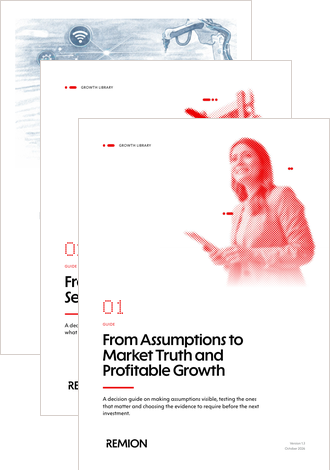
Short decision guides on what to test, what to build and what to prove before you scale – with quick checks that show where to start. One sign-up gives you all guides, in English and Finnish.
Growth Guides
Short decision guides on what to test, what to build and what to prove before you scale. One sign-up gives you all of them, in English and Finnish.
Get the guides
Industrial IoT 2025 study
15 interviews and 27 survey responses from European industrial OEMs show where connectivity ends and business value begins — a public example of the evidence behind a growth decision.
Get the studyQuick checks
Growth Check finds the first decision that lacks evidence. Customer Outcome Check shows how well you learn what customers need before you build. Data Readiness Check shows whether your industrial data can support the decision you want to make. Each takes minutes and needs no sign-up.
Can we help you to scale?
Whatever way you decide today, we can help you move to an outcome-led decision faster.
01
Growth Direction Day
One 3–5-hour executive workshop that locates the earliest unsupported step and names the next move.
Read more →
02
Growth Path Advisory
The full evidence-led path from customer needs to a scalable business – one stage or all five.
Read more →
03
Interim Growth Advisory
A senior advisor alongside your management, commercial and technical teams across consecutive growth decisions, typically at 20–100% allocation.
Read more →
Ready to take the next step?
Let’s explore how data can improve your operations, unlock new revenue, and drive smarter decisions.

